Quick Answer: Renters Insurance in Texas: Cost, coverage, and lease rules come down to a few numbers. The Texas Department of Insurance puts the average Texas policy near $20 a month. No state law requires you to buy one, but most Houston apartment communities do, usually asking for $100,000 in personal liability and proof of coverage before move in day.
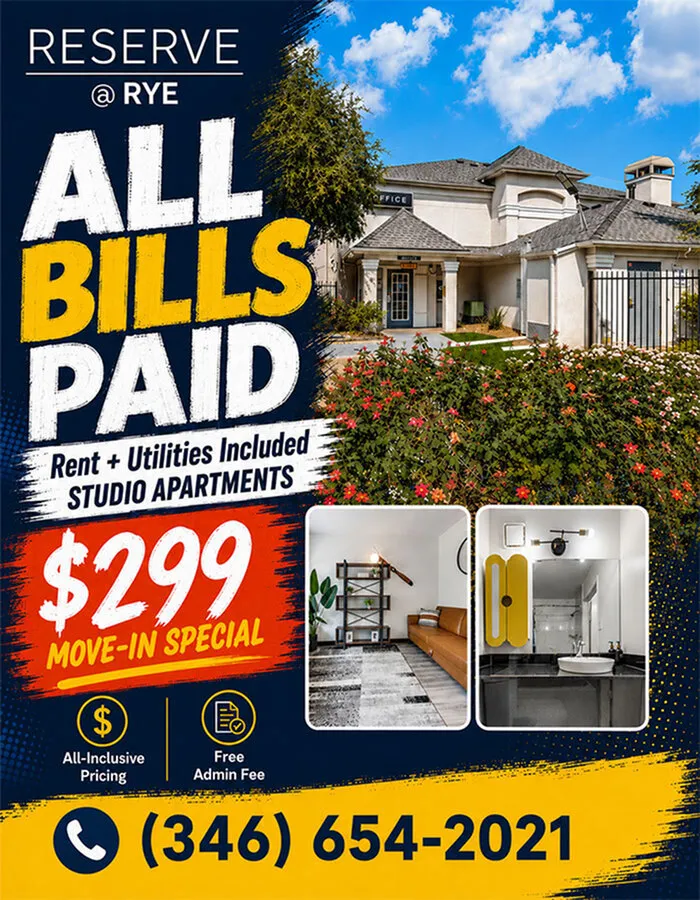
About $20 a month. That is what the Texas Department of Insurance says a typical policy runs, which makes Renters Insurance in Texas: Cost less of a budget problem and more of a paperwork problem. Residents at The Reserve at Rye 290, a gated studio community serving the Fairbanks and Northwest Crossing area along US-290 in Houston, run into the requirement the same week they sign a lease.
What Insurance for Apartment Renters Actually Covers
Insurance for apartment renters protects three things: your belongings, your legal liability, and your living costs if the unit becomes unlivable. It does not protect the building. The Texas Department of Insurance is blunt about that split. The owner's policy repairs the structure, and your policy replaces what you carried through the door.
Renters Insurance for Theft, Fire, and Water Damage
Most policies pay for fire, smoke, theft, vandalism, and certain kinds of sudden water damage such as a burst pipe or an overflowing toilet. Renters insurance for theft carries quiet limits, though. TDI lists common caps of $100 for cash, $2,500 for property used for business, and $500 for jewelry and watches. Own a good camera or a ring? Ask about scheduling those items separately.
Flood is the exclusion that catches people off guard. Standard policies do not cover it anywhere in Texas. FEMA's National Flood Insurance Program sells renters a contents only policy worth up to $100,000, and it normally takes 30 days to take effect. In a metro that has lived through Harvey and Beryl, that gap deserves a real conversation.
Rental Loss Insurance for Living Expenses
Rental loss insurance is the piece nobody thinks about until they need it. If a kitchen fire makes your apartment unlivable, the loss of use section pays for a hotel or a short term rental while repairs happen. Limits apply, so read that page rather than assuming it funds three months away. TDI also notes some policies pay up to $500 for food spoiled during a covered power failure.
Renters Insurance in Texas: Cost Ranges in 2026
Published averages disagree, and the spread is worth knowing before you shop. TDI puts the state figure near $20 a month. Private rate trackers surveyed in mid 2026 landed between roughly $205 and $264 a year for Texas, with Houston quotes running above the statewide number because of hurricane and hail exposure along the Gulf Coast.
Four things move your quote more than the brand name on the policy:
- Coverage limit, usually $20,000 to $40,000 in personal property
- Deductible, where moving from $500 to $1,000 trims the annual premium
- ZIP code, since local theft and storm claims feed directly into the rate
- Credit based insurance score, which Texas permits insurers to use
Rental insurance in Texas stays cheap relative to almost everything else on a lease ledger. Set it next to a parking charge or a pet fee and the math gets easy, especially in a studio where compact floor plans mean a shorter inventory to insure in the first place.
How to Get Affordable Renters Insurance Without Gutting Coverage
Get three quotes. Bundle with auto if you carry it. Then do the step most renters skip: walk each room and estimate what replacing everything would cost today. Affordable renters insurance is not the cheapest premium on the page. It is the lowest price that still replaces your mattress, laptop, and clothes. Ask whether the policy pays replacement cost or actual cash value, because that choice changes what lands in your account after a loss.
Is Renters Insurance Required in Texas?
No Texas statute requires it. Chapter 92 of the Texas Property Code governs residential tenancies and never forces a tenant to buy coverage. Your lease can, and in professionally managed Houston communities it almost always does. Once you sign, that clause is enforceable like any other term in the agreement.
Expect the lease to name a minimum personal liability limit, commonly $100,000, and to ask that the community be listed as an interested party so it receives notice if your policy lapses. Bring the declarations page to move in. Communities with controlled access and gated parking still require proof, because the clause exists to sort out liability for damage you cause, not to rate how secure the property is.
What a Building Loss Protection Fee Covers, and What It Skips
Some communities enroll residents in a liability waiver program instead. A building loss protection fee, billed elsewhere as a damage waiver or tenant liability waiver, typically runs $10 to $20 a month and satisfies the lease requirement automatically. Here is the catch that surprises people: it is not insurance, and it does not cover a single item you own.
| Feature | Your own policy | Liability waiver fee |
|---|---|---|
| Typical monthly charge | $15 to $25 | $10 to $20, added to rent |
| Your furniture and electronics | Covered to your limit | Not covered |
| Theft or vandalism loss | Covered, subject to sub limits | Not covered |
| Hotel stay after a fire | Paid under loss of use | Limited or none |
| Damage you cause to the unit | Liability, often $100,000 | Waived, often to $100,000 |
| Moves with you | Yes | No, it ends with the lease |
| Regulated as insurance in Texas | Yes, by TDI | No, it is a contract term |
Waivers are convenient. They are also a landlord protection product wearing a resident's name, so treat the fee as compliance rather than coverage.
Frequently Asked Questions
1. How do renters insurance claims work in Texas?
Renters insurance claims move fastest when you document first and call second:
- File a police report for theft or vandalism and keep the report number
- Photograph the damage before you clean anything up
- List what was lost, with model numbers and rough purchase dates
- Call your agent or carrier to open the claim
- Save receipts for hotel nights and emergency repairs
2. Does my roommate's renter's insurance cover my belongings?
No. TDI is direct on this point: a roommate's policy pays only for that roommate's property. If a fire or burglary hits the unit, your things are covered only by your own renter's insurance. Two people on one lease need two policies, and both are still inexpensive.
3. How much liability coverage do Houston apartment leases require?
Most Houston communities set the minimum at $100,000 in personal liability. Some ask for more if you have a dog of a restricted breed. Read the insurance addendum rather than guessing, since a policy below the stated limit leaves you out of compliance from day one.
4. Does a policy cover items stolen from my car?
Usually yes. TDI notes most renters policies pay for belongings stolen out of your vehicle, subject to your deductible and sub limits. The car itself is an auto policy matter. A stolen laptop bag falls under renters coverage, a broken window under comprehensive auto.
5. Can I drop the waiver fee if I buy my own policy?
In most programs, yes. Upload your declarations page to the community's compliance portal and the fee comes off your ledger going forward. Submit proof before your next rent posting, then confirm with the leasing office that the charge was removed.
Renting Smart in Northwest Houston
Twenty dollars a month buys more certainty than almost any other line on a lease. A policy replaces your belongings, absorbs a liability claim, and pays for a hotel when a neighbor's burst pipe reaches your ceiling. A waiver fee does none of that. Compare quotes, match the limit to a real inventory, and hand the declarations page to your leasing team before keys change hands.
For studio renters looking at the Fairbanks and US-290 corridor, coverage decisions sit alongside commute and budget questions, and the neighborhood and directions page is a good place to start mapping the rest. Confirm current lease requirements with the leasing office, and call the TDI Help Line at 800-252-3439 with policy questions. Rates and rules cited here reflect sources reviewed in August 2026.